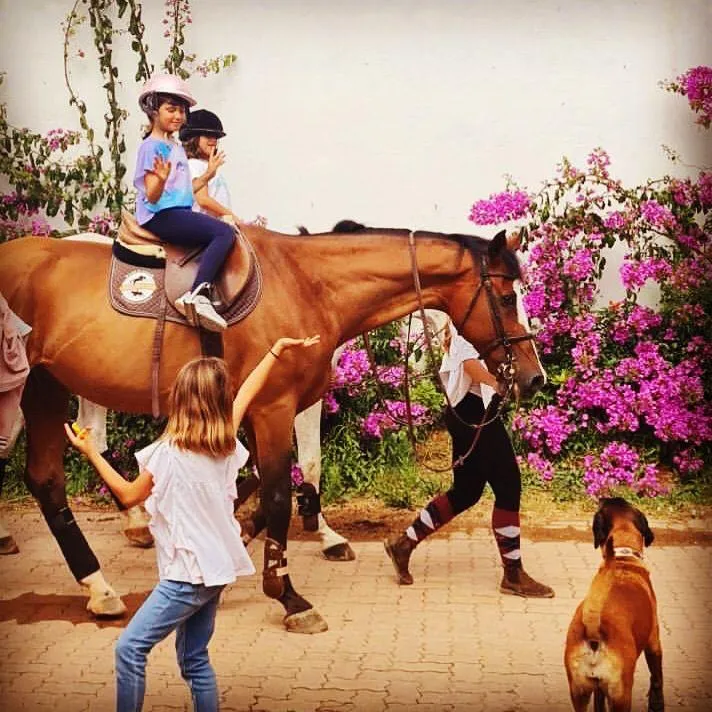
Most people who try horse riding for the first time as an adult arrive with a version of the same three worries: Am I too old? Am I too heavy? What if the horse senses I’m nervous?
This guide answers those questions honestly — and explains what a first lesson at a proper riding school actually looks like, step by step.
Is there an age limit for starting horse riding?
No. There is no upper age limit for learning to ride.
The youngest students at Miguel Alves Horses start at age 5. The oldest adults who have started from zero? Well into their 60s. Riding develops balance, coordination and core strength — all of which adults already have more of than children, even if they don’t feel that way at first.
What changes with age is not your ability to learn but your relationship with risk. Adults tend to be more cautious, which is actually an asset: you listen more carefully, follow instructions precisely, and don’t try to show off. Instructors often find adult beginners easier to teach than teenagers.
Common fears — answered
”I’m too heavy for the horse.”
Riding schools operate with weight limits, typically around 90–100 kg depending on the horse. This isn’t an arbitrary rule — it’s a welfare guideline. If you’re close to or above that range, contact the school before booking. At Miguel Alves Horses, the limit is 100 kg.
If you’re under the limit: this concern is completely unnecessary. Horses are large animals built to carry weight. Your size has no bearing on your ability to ride.
”The horse will sense I’m nervous and act up.”
Horses are sensitive to body language, which is part of what makes them compelling to work with. But a calm, experienced school horse does not suddenly become dangerous because a rider is tense. What you may notice is that tension in your body affects your communication with the horse — a stiff grip on the reins can confuse a horse that’s responding to subtle signals. Your instructor will help you relax your posture as part of the lesson.
The horses used for beginner lessons are specifically chosen for temperament. They’ve done this hundreds of times.
”I’ll look ridiculous.”
Every experienced rider was once a beginner. Instructors teach beginners every day — they are not judging your coordination or laughing at your position. The only thing that marks a good student in a first lesson is willingness to listen and try again.
What happens in a first lesson
A first adult lesson at Miguel Alves Horses runs 50 minutes and follows a consistent structure:
1. Introduction and safety briefing (10 min)
Before you go anywhere near the horse, your instructor covers:
- How to approach a horse safely (always from the front quarter, never from directly behind)
- The meaning of basic horse behaviour — ears back vs. forward, weight shifting
- Emergency stop: how to pull both reins simultaneously to halt
- How to fall safely — not a scare tactic, just good practice
2. Tacking up (5 min)
You’ll watch the instructor saddle and bridle the horse, and learn the names of the main equipment. You won’t be expected to do this yourself in your first session.
3. Mounting (5 min)
Mounting is the moment most adults find unexpectedly difficult — not because it’s dangerous, but because it requires a specific sequence of movements that feels awkward until you’ve done it twice. The instructor supports you throughout. The horse stands still.
4. Walk work in the arena (20–25 min)
The bulk of your first lesson is spent at a walk in the arena:
- Learning to hold the reins correctly — relaxed hands, consistent contact
- Steering: how to ask the horse to turn left and right
- Halting: practising the stop consistently
- Posture: heels down, back straight, shoulders soft
- Building confidence at a rhythm you control
Most beginners are surprised by how much there is to think about at a walk before trotting becomes relevant.
5. First trot (optional, 5–10 min)
If you’re balanced and comfortable at a walk, your instructor may introduce a short trot. This is not guaranteed in a first lesson — your instructor judges the right moment. The trot is a bouncy gait that requires relaxed hips; most beginners find it takes a few sessions to feel natural.
6. Dismounting and cool-down (5 min)
Dismounting is covered the same way as mounting — step by step, with instructor support. You may help walk the horse back to the stable.
What to wear
You don’t need to buy any riding equipment for a first lesson:
Trousers: Any comfortable, close-fitting trouser. Avoid stiff denim — the inner seam rubs against the saddle. Leggings, tracksuit bottoms and chino-style trousers all work well.
Shoes: Closed toe, flat sole or slight heel. Ankle boots, wellies, casual leather boots. Avoid thick-soled trainers (the foot can get stuck in the stirrup) and any open-toe footwear.
Top: Whatever you’d wear to a gym class. A light jacket if it’s cold.
Helmet: Provided free of charge by the school in all sizes.
After your first lesson
Most adults describe their first lesson the same way: harder than expected, and immediately addictive.
The challenge is not physical fitness — it’s the coordination of multiple new signals at once. You’re managing your posture, your hands, your legs and your attention all simultaneously. It’s a lot. But it’s also the reason riding is genuinely engaging, even at a basic level.
Progress is fast in the first few months. Most adult beginners who ride once a week are trotting comfortably within 4–6 sessions and cantering within 3–4 months.
Lesson options and prices
| Lesson type | Duration | Price |
|---|---|---|
| Beginner (individual) | 30 min | €40 |
| Drop-in (individual) | ±1h | €60 |
| Monthly plan — 1×/week | 4 lessons | €140/month |
| Monthly plan — 2×/week | 8 lessons | €240/month |
Prices excluding VAT. Individual lessons can be booked as a one-off — no commitment required for a first try.
Where we are
Miguel Alves Horses is based at the Centro Hípico da Quinta da Marinha, Cascais — 30 minutes west of central Lisbon via the A5 motorway. Free parking on site.
The school is open every day, 08:00–20:00. English, Portuguese and French spoken.